

Since late 2025, the PCB industry has experienced one of the tightest supply cycles in recent memory. What began as isolated raw material price increases has evolved into a structural shift across the entire supply chain — driven by AI infrastructure investment, capacity reallocation, and compounding cost pressures across copper, laminates, glass fabric, and epoxy resin.
This is not a temporary disruption. As NCAB Group put it in its May 2026 supply chain outlook, the industry is undergoing a “seismic reset” — not a cyclical fluctuation, but a fundamental restructuring of how PCBs are sourced, priced, and delivered.
AI Servers Are Consuming PCB Material at an Unprecedented Scale
AI servers consume significantly more PCB material than traditional enterprise servers. A single AI server uses 10 to 15 times the PCB area of a standard server, with layer counts 3 to 5 times higher.
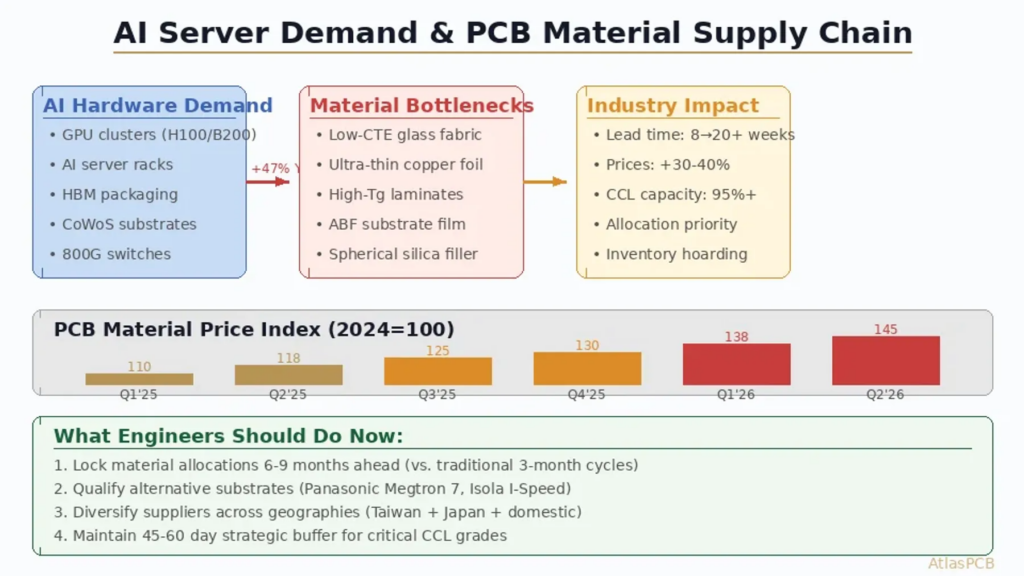
Also, Goldman Sachs raised its 2026 global AI PCB market forecast by 35% to $13.56 billion, and projects the market to reach $37.5 billion in 2027 and $84 billion in 2028.
Capacity Has Been Fully Absorbed by AI Orders
NCAB Group, one of the world’s largest PCB procurement companies, described the current market condition as a “structural reset” of the global PCB supply chain. AI-related PCB technologies — high-layer multilayers, HDI, low-loss materials — have pushed factory utilization to unprecedented levels. The impact is now spilling over to non-AI products. Standard 4-6 layer boards that previously shipped in 5-7 days are now quoting 10-15 days at some factories.
Prices Are Rising Across the Board
- Copper. LME copper traded at $14,147.50 per tonne on May 13, 2026, marking eight consecutive sessions of gains. The metal has traded above $14,000 per tonne for much of 2026, approaching the January record of $14,527.50.
- CCL (Copper Clad Laminate). South Korean CCL import prices reached $20,728 per tonne in March 2026 — up 74.5% year-over-year and the first time above $20,000 since records began in 2000, according to Korea Customs Service data.
- Glass Fabric. TrendForce has identified glass fiber cloth as a critical bottleneck in the AI server supply chain. The shortage is expected to persist through at least the second half of 2027. One Seoul-based PCB maker reportedly placed advance orders worth KRW 10 billion (approximately $7.2 million) with Taiwanese suppliers — more than five times its typical monthly usage — to secure supply.
- Epoxy Resin. According to Reuters, the Middle East conflict has stretched epoxy resin lead times from 3 weeks to 15 weeks. A senior executive at South Korean PCB maker Daeduck Electronics — whose customers include Samsung, SK Hynix, and AMD.
Lead Times: From Weeks to Months
The lead time picture across the industry has shifted dramatically:
- Standard FR-4 laminate: 2-3 weeks → 6-8 weeks; advanced low-loss laminates: 14-18 weeks
- Standard 2-4 layer PCBs: 1-2 weeks → 2-3 weeks;
- 6-12 layer PCBs: 2-3 weeks → 3-4 weeks;
- HDI (any-layer): 3-5 weeks → 5-7 weeks
- 16+ layer complex boards: 4-5 weeks → 7-10 weeks (some designs exceeding 12 weeks); premium expedite fees have increased 20-30% since Q4 2025

TrendForce reported that PCB and CPU lead times have extended to nearly a year for some components, with PMIC lead times stretching from 21-26 weeks to 35-40 weeks.
How ABIS Approaches Support
Market conditions are beyond our control — but responsiveness, capability, and quality are not. ABIS Circuits is a one-stop PCB and PCBA manufacturer built for speed and flexibility: quick-turn prototyping, in-house fabrication and assembly, and certified quality from ISO to IATF16949. When supply chains tighten, we keep your projects moving.


